
El Niño winters can bring Southern California heavier, longer, and more frequent rain than a typical season, often in back-to-back storms that give a roof no time to dry out. Most of the leaks we see after those storms do not come from a sudden failure. They come from small problems that were already there: a clogged drain, a cracked pipe boot, a tired flat-roof coating. A little prep now can save you a lot later.

1. Check for visible roof damage
From the ground, a window, or a safe upper-floor vantage point, look for cracked, missing, or curling shingles, slipped or broken tiles, and tears or punctures on flat roofs. Binoculars help. Take photos so you have a before-the-storm record.
2. Clear gutters and drains
Remove leaves and debris from gutters, downspouts, scuppers, and roof drains, and make sure water flows freely away from the building. When gutters overflow during a heavy storm, water backs up under roof edges and into fascia, walls, and foundations.
3. Inspect flashing
Flashing is the metal and sealant that protects roof edges, walls, chimneys, vents, skylights, and other penetrations. It is the most common leak point on almost every roof type. Look for lifted edges, rust, gaps, or dried and cracked sealant.
4. Look for interior leaks
Walk the top floor and the attic, if you have one. Water stains on ceilings, bubbling paint, discoloration around light fixtures, or a musty smell all point to moisture that is already getting in. Small stains before the season usually become big ones during it.
5. Evaluate flat roof areas
Flat roofs on homes, garages, ADUs, apartments, and commercial buildings need extra attention. Look for ponding water that stays more than a day or two after rain, cracks, blisters, open seams, and worn or deteriorated coating. Ponding water finds every weak spot during a long storm.
6. Check roof vents
Make sure plumbing vents, attic vents, and exhaust caps are secure and that their flashing and rubber seals are intact. Pipe boots crack in the Southern California sun and are one of the most common sources of winter leaks.
7. Review roof age
Older roofs should be professionally evaluated before the wet season. As a rough guide, asphalt shingle roofs over 15 to 20 years old, flat roofs and coatings over 10 to 15 years old, and tile roofs whose underlayment has never been replaced are worth a closer look, even if nothing is leaking yet.
8. Schedule a professional roof inspection
A professional inspection identifies problems before rain turns them into costly repairs. It also gets you on the schedule before the first big storm, when every roofer in Los Angeles gets busy at once.
The quick checklist
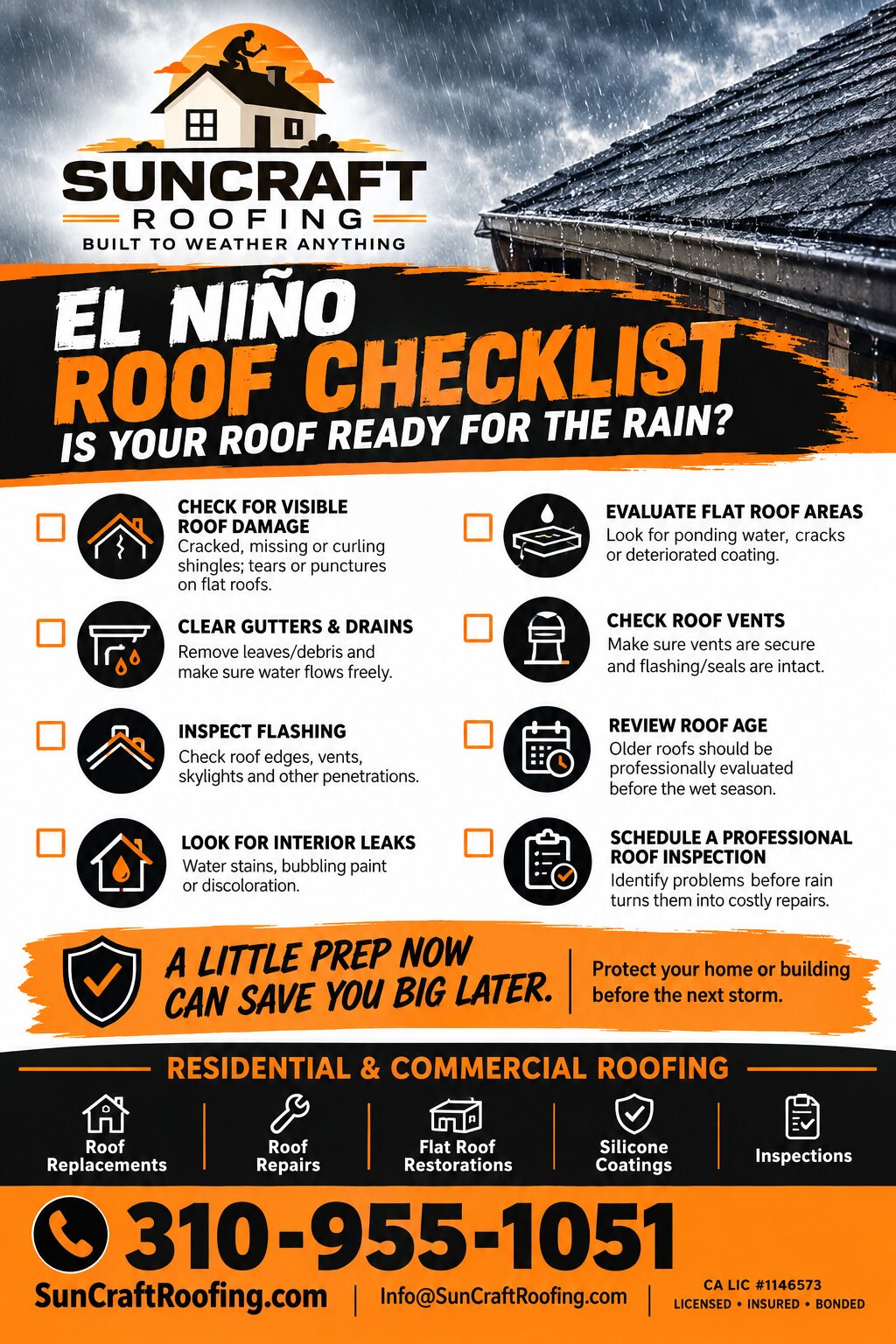
- Check for visible roof damage: cracked, missing, or curling shingles; tears or punctures on flat roofs
- Clear gutters and drains: remove leaves and debris and make sure water flows freely
- Inspect flashing: roof edges, vents, skylights, and other penetrations
- Look for interior leaks: water stains, bubbling paint, or discoloration
- Evaluate flat roof areas: ponding water, cracks, or deteriorated coating
- Check roof vents: vents secure, flashing and seals intact
- Review roof age: older roofs should be professionally evaluated before the wet season
- Schedule a professional roof inspection before the rain arrives
Stay safe while you check
Most of this checklist can be done from the ground, a window, or inside the house. Do not walk on a wet, steep, or tile roof, and do not climb a ladder alone. If something needs a closer look, that is what a roof inspection is for.
When to call SunCraft
If the checklist turns up anything you are not sure about, or you just want a professional set of eyes on the roof before El Niño storms arrive, call SunCraft Roofing at 310-955-1051. We handle residential and commercial roof repairs, replacements, flat roof restorations, silicone coatings, and inspections across South Bay LA, Greater Los Angeles, Long Beach, and Orange County. CA License #1146573. Licensed, insured, and bonded.